







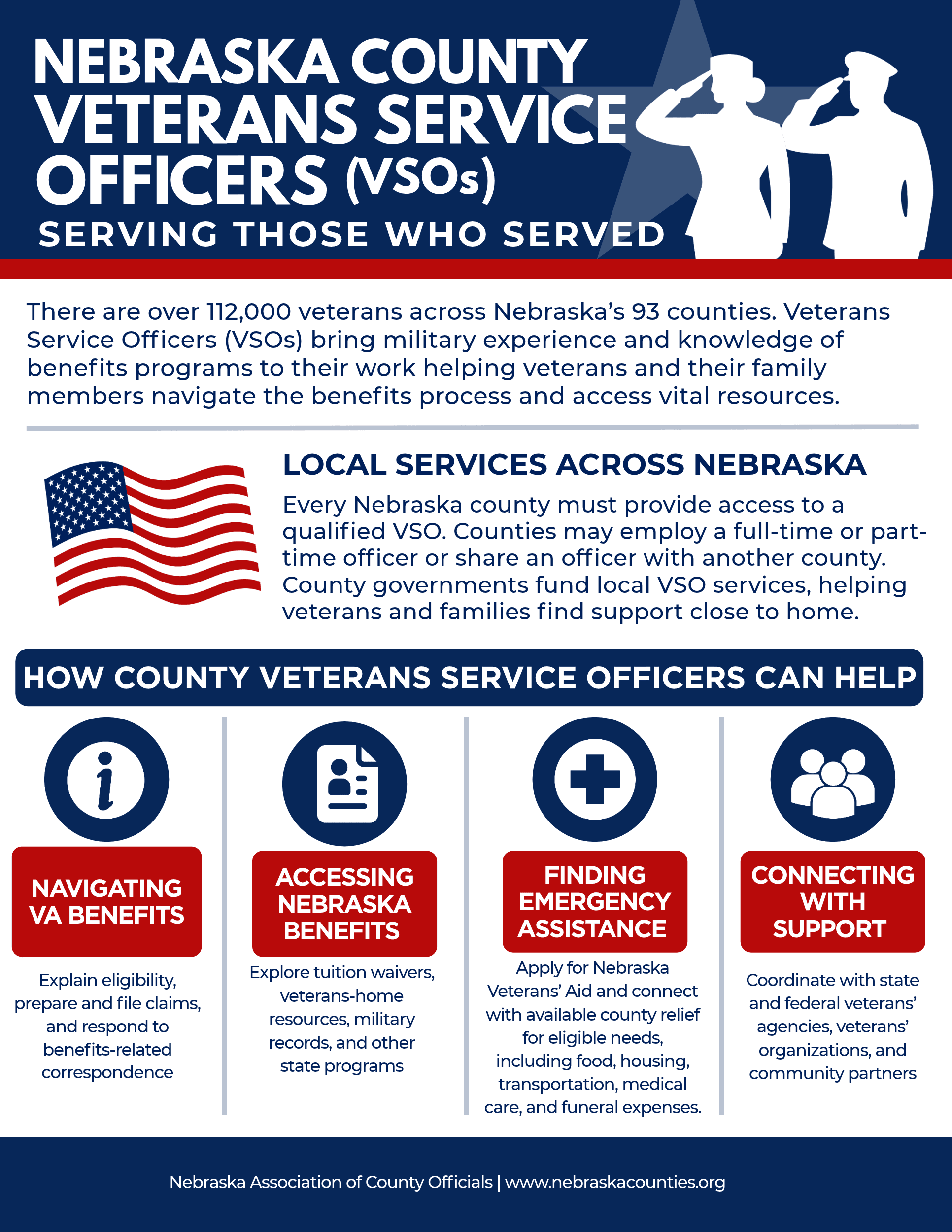
There are more than 112,000 veterans across Nebraska’s 93 counties. Veterans Service Officers (VSOs) bring military experience and knowledge of benefits programs to their work helping veterans and their family members navigate the benefits process and access vital resources.
Lancaster County VSO Mark Lakamp said that day-to-day, a VSO helps Veterans and their families access the various federal, state, and local benefits their service entitles them to.
“A large portion of our work is helping Veterans file disability claims with the Veterans Benefits Administration. We go over the Veteran’s specific situation and history, determine which conditions they have reasonable claims for, complete the VA forms with the Veteran, obtain and submit any required evidence, and then track the claim through the VA’s decision process. If the VA makes an error (and they often do), we help the Veteran file the appeal and get the decision that federal law and regulations require,” he said.
VSOs also help Veterans access benefits as Nebraska Veterans Aid for Veterans who are undergoing an unforeseen financial emergency and administer the County Veterans Aid fund for similar purposes. They process and submit applications to the Nebraska Veterans Homes and assist Veterans with Veterans Health Administration issues. In short, they are a one-stop shop for Veterans and their families for any questions they may have regarding benefits that are, or may potentially be, available to them.
Lakamp has served as the Lancaster County VSO for a little over four years. He said that his experience as a Veteran is invaluable because he “speaks the same language” as the Veterans he helps.
“We have shared experiences, even if we served in different branches,” he said. “I am also trained in the language the VA speaks, and the ability to translate back and forth helps the Veteran explain their situation in a way the VA claims processors understand.”
VSOs provide their services at no cost to the Veteran, something that can’t be said of the outside companies or consultants that Veterans sometimes use to navigate the claims process.
“We only have the Veteran’s interests in mind, not making money from them. In 2025, our office helped Veterans file claims and appeals that resulted in $4.4 million in retroactive payments and annual increases of $6.7 million. If our Veterans had gone to an accredited attorney, or an illegal, unaccredited “claims consultant, they would have paid between $880,00 and $1.2 million dollars for those decisions,” Lakamp said. “It is important to understand that our Veterans Service Officers are accredited by the Veterans Administration through the National Association of County Veterans Service Officers (NACVSO), Veterans of Foreign Wars (VFW), The American Legion, and Disabled American Veterans (DAV). These are the “Big Four” Veterans Service Organizations that work tirelessly on behalf of Veterans across the country. If a Veteran's claim should need to go past the Board of Veterans Appeals (BVA) to the Court of Appeals for Veterans Claims (CAVC), those organizations will pick up their claims with their highly trained lawyers to ensure the Veteran gets a fair hearing of their claim.”
A few months ago, Lakamp was contacted by the daughter of a 91-year-old Veteran who was having difficulty getting enrolled in VA Health Care. He looked into the situation and found that he was not eligible for enrollment because his service was in the Nebraska National Guard in the 1950s with no active duty.
“I explained that if he had a service-connected disability, he would be eligible for VA health care. He replied that he had been denied service connection for his hearing loss several years earlier because the VA could not locate his service records and could not verify his service. He chose The American Legion as the Veterans Service Organization to represent him, and I got access to his online VA file. Review of that file showed that he had a very significant hearing loss shown in a private audio exam he submitted with his claim, but the VA denied the claim because they could not locate his service treatment records to determine whether there was any evidence that hazardous noise in service had caused or contributed to that hearing loss.”
Based on this, Lakamp contacted the Nebraska National Guard Joint Force Headquarters to see if they had any of his records in their archives. Fortunately, they did, and those records were sufficient to show a link between his service and his hearing loss. They put together what is known as a supplemental claim. This is a type of appeal where a Veteran can ask the VA to look at a previously denied claim by providing new and relevant evidence. This new evidence allowed the VA to service-connect the Veteran for hearing loss and tinnitus. His hearing was so bad that he was granted a 100% permanent and total rating. This disability rating made him eligible for enrollment in VA health care with zero copays or other out-of-pocket expenses.
“He became eligible for VA-funded nursing home care should he ever need it, and a monthly disability payment of a little over $ 4,000 per month. Because the VA initially denied his claim due to a lack of service records, he fell under a rule that, should those service records become available in the future and result in a service-connected disability, the effective date of the award would go back to the date the claim was first filed. This resulted in a retroactive payment of a little over $100,000 to the Veteran. This was a life-changing event for the Veteran. He and his wife were able to buy a house next door to their daughter, and the daughter is now part of the VA Family Caretaker program that pays family members to provide care to Veterans who would otherwise need nursing home care,” Lakamp said. “This particular case is an extreme example, but it shows how county VSOs can make a big difference in a Veteran’s life. Our office has 4 VSOs, and across the state there are VSOs in every county ready to help Nebraska’s Veterans navigate the complicated red tape that often hinders them.”